
GenAI and SEO
Help Your Content Get Found
Having a good website is no longer enough. The rise of generative AI has fundamentally changed how people search for information—and, perhaps more importantly, how much effort they’re willing to invest to find it. Increasingly, users expect immediate, direct answers without having to visit multiple websites.
To remain relevant, our websites must adapt to this new search landscape. Otherwise, we risk losing visibility, value, and purpose as users turn to AI-powered tools instead of visiting our sites for the information they need.
How AI is Changing the Way We Think About Our Websites
In this presentation, we’ll discuss the impact that AI tools and searches such as ChatGPT and Google AI Overview are having on our content and what steps we should be taking to stay visible (and relevant) in a constantly evolving digital landscape.
AI is everywhere.
Artificial intelligence has quickly become part of our everyday lives. It’s built into our phones and computers, powers our smart devices, personalizes our streaming services, and is increasingly integrated into the websites and apps we use every day. Whether we embrace it or not, AI is becoming a standard part of the digital experience.
As AI continues to influence how people find and consume information, it’s no surprise that many of our audiences are using generative AI (GenAI) tools like ChatGPT, Google AI Overviews, and Perplexity to learn about Wake Forest. These tools provide fast, convenient answers, making them an increasingly common starting point for researching universities, programs, and services.
It’s also important not to overlook traditional SEO. While generative AI is changing how people search for information, search engines remain one of the primary ways users discover our content. Later in this section, we’ll explore why SEO continues to play a critical role in the visibility and success of our website content.
Zero-Click Searches
A zero-click search occurs when a user finds the information they need directly within the search results or an AI-generated response and never clicks through to a website. As search engines and AI-powered tools provide more complete answers, zero-click searches are becoming an increasingly common way people learn about Wake Forest and what we have to offer.
In the first half of 2026, more than 68% of all searches on Google did not result in a click to anywhere.
Source: In 2026, Less than One Third of Google Searches Still Send a Click
This raises an important question: If people are still searching for information about Wake Forest, how do we know they’ll ever visit our website?
The convenience of AI-powered tools such as ChatGPT, Google Gemini, and Perplexity has made it easier than ever for users to get answers without clicking through to a website. Although industry research shows that many people remain cautious about fully trusting AI-generated responses, that skepticism hasn’t diminished their use of these tools.
As zero-click searches become more common, we need to broaden how we think about content visibility. It’s no longer enough to focus solely on driving traffic to our websites—we also need to ensure our content is accurate, authoritative, and visible enough to be cited in the AI-generated responses that many users read before deciding whether to visit our site at all.
SEO, GEO, and Generative AI
As previously mentioned, there are two primary ways users find information about us:
- Traditional search engines (Google, Bing)
- Generative AI (ChatGPT, Google AI Overview)
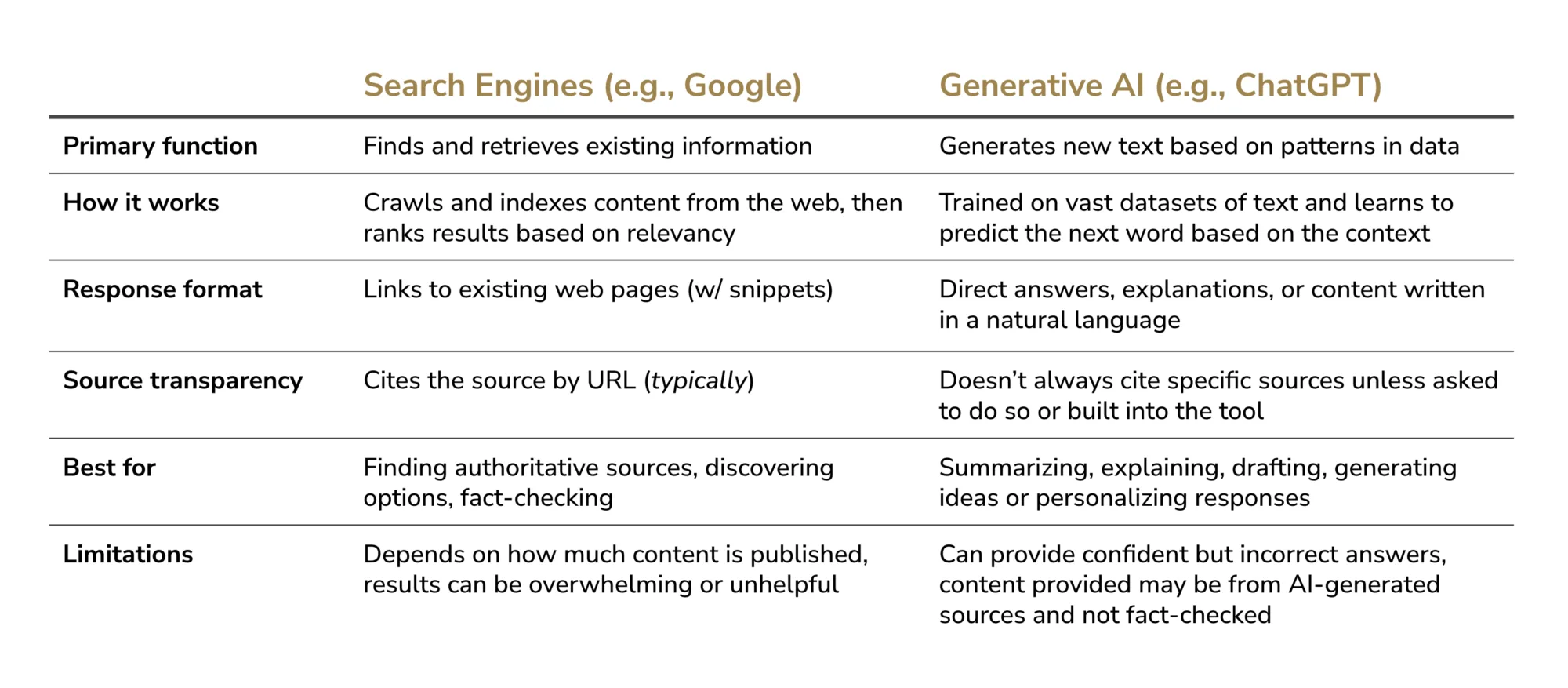
Generative AI and traditional search engines serve different purposes. Generative AI is designed to answer questions by synthesizing information into a conversational response, while search engines are designed to help users discover sources that contain the information they’re looking for.
If a search engine is a gateway, generative AI is a guide.
In both cases, users can choose whether to visit the websites referenced in citations or search results. The key difference is that AI-generated responses often provide enough context and detail to answer a user’s question without requiring them to click through to another site. For many users, that convenience is enough, making it increasingly important that our content is not only discoverable, but also cited as a trusted source.
SEO vs. GEO
Many of us are already familiar with SEO, or search engine optimization. SEO is the practice of improving a website to increase its visibility and ranking on search engine results pages (like Google).
GEO is what happens when SEO evolves for the AI era. Instead of optimizing for ranking, we’re optimizing for representation or visibility. This is what GenAI tools use as their LLMs (large language models) and how they retrieve and summarize information.
Both SEO and GEO play important roles in today’s digital search landscape, and neither is going away anytime soon. As we create content for our websites, we need to consider how both traditional search engines and AI-powered search tools discover, interpret, and present our information.
The goal is no longer just to rank highly in search results. We also need to ensure our content is authoritative and well-structured enough to be surfaced and cited by AI-generated search experiences. Increasingly, success isn’t measured solely by where we rank—it’s also measured by whether our content is represented accurately and cited at all.
External vs. Internal Searches
Up to this point, we’ve focused on external search, particularly as it relates to GenAI. In the next section, we’ll shift our attention to traditional SEO. Before we do, it’s important to understand the role internal search plays in helping users find content once they’ve already arrived on a WFU website—and how those users differ from visitors coming from outside the wfu.edu domain.
External and internal search serve two very different purposes. External search engines and GenAI platforms are the primary way people discover websites, with more than 68% of online experiences beginning with an external search in 2026, according to Search/Atlas. By comparison, internal site searches (in general, not WFU-specific) account for only about 30% of searches, meaning far fewer users rely on a website’s search functionality after they’ve arrived.
Once users are on the wfu.edu website, there are two types of internal search available: the WFU Global Search (Google Custom Search) and the WordPress site search. Including external searches, each search type serves a different purpose:
- External search (e.g., Google, ChatGPT): The primary way most users discover and access information online.
- WFU Global Search (Google Custom Search): Designed for users who are already on a WFU website and want to locate information across the broader wfu.edu domain. These users typically have a general idea of what they’re looking for but need help finding the right page.
- WordPress Site Search: Best suited for websites with a large volume of content, such as policies, documentation, news archives, or resource libraries. It should not be viewed as a general-purpose navigation tool or a substitute for clear site organization and intuitive navigation.
Siteimprove Core Wins & SEO Tracking
Let’s take a deeper look at two Siteimprove features in this presentation: Core Wins and Search Engine Analytics. Core Wins can help you address issues on your site that affect your users the most while Search Engine Analytics will show you how users are finding your site and engaging with your content.
Why SEO is Still Important
I’m sure you’re all aware of what SEO, or search engine optimization is, and the role it plays in how users learn about us and get to our website. In case you don’t, let’s cover some of the basics.
Taken directly from the undisputed leader in search, here’s how Google defines SEO:
SEO (Search Engine Optimization) is the practice of improving your website so it appears more prominently in unpaid (organic) search results on search engines like Google and Bing. The goal is to make your content easier for search engine crawlers to understand and index, while also making it easier for users to discover.
In other words, SEO is the discipline that has shaped how web pages are found in traditional search engines for more than three decades. Despite the growing influence of GenAI search tools, SEO remains an important practice in how users every day learn about us and visit our websites.
Here are a few reasons why it’s still important to take the necessary steps to stay relevant in SEO searches.
- Search engines generate lots of traffic. Ranking high in search engine results pages can get you lots of clicks. Which means lots of traffic to your website.
- SEO can be highly cost effective. It doesn’t cost anything (except time and effort).
- Search visibility drives brand awareness. Similar to being mentioned in citations produced by GenAI tools, having your page show up in a search result can increase awareness amongst web users.
- SEO results are quantifiable. While metrics like pageviews and visits are no longer reliable indicators of engagement, user traffic that arrives to your website from search engine results (referrers), and how that’s measured, can still provide valuable insight into the topics and content that attract your audience’s attention while creating conversions.
Now that you understand why SEO is still important, let’s address some steps you can take to optimize your website and its content for search engines.
How to Improve Your SEO
You can make some noticeable improvements to your SEO in just a few minutes if you know where to look. Let’s take a look at a few steps you can take to get started.
1. Optimize title tags and meta descriptions.
Your page title and meta description are often the first things users see in search engine results pages (SERPs). Because they play a significant role in whether someone chooses to click on your page, they should be clear, descriptive, relevant to the page’s content, and include important keywords where appropriate.
To help optimize this information, every UMC WordPress site includes the Yoast SEO plugin. At a minimum, be sure each page has a well-written page title and meta description. These elements not only improve how your content appears in search results.
2. Improve your page speed.
Fast-loading websites provide a better user experience and are more likely to perform well in search results. Large files, unoptimized images, and excessive scripts can slow page load times, frustrating users and making it more difficult for search engines to efficiently crawl and rank your content.
Use tools like Google PageSpeed Insights to evaluate your website’s performance, identify technical SEO issues, and fix them to enhance user experience and search engine optimization.
You can also use Siteimprove’s Quality Assurance, SEO and Accessibility modules to identify assets that may be slowing down your pages, as well as uncover issues that could negatively affect your site’s search performance.
3. Structure your content with intent and clarity.
A well-structured page helps both users and search engines understand your content. Use a clear heading hierarchy and consistent formatting to improve search visibility and make your content easier to read and navigate.
- Use keyword-rich headings. Each header should signal relevance to specific keywords or search queries.
- Use headers to organize. Start with a strong H1, then use H2s and H3s to logically support each section.
- Write for readability. Short paragraphs, white space, and lists improve scannability.
- Address one idea per section. Keep each part focused and self-contained.
4. Take advantage of your web analytics.
Whether you use Siteimprove Analytics or GA4, take advantage of the insights they provide to monitor your website’s performance, understand how visitors use your site, and identify issues before they become larger problems.
If you’re interested in learning more about SEO and what you can do to improve your site’s performance, reach out to the UMC digital team and we’d be happy to set up a personal consultation with you.
Looking for some quick SEO wins? Check our the SEO section on our Quick Wins page for a few tips on what you can do if you just have a few minutes of time to spare.
Your Digital Strategy Toolbox

Content
A well-defined web content strategy drives user experience, content visibility, and overall website performance.

Analytics
Analytics help you uncover insights, identify trends, and guide improvements for your website content strategy.

GenAI & SEO
How people discover information has changed—and continues to evolve. Here’s why that matters and how to approach it.

Accessibility
An effective website is designed not only for its intended audience, but to ensure everyone can access its content.
Online Presentations
Whether you’re interested in attending an upcoming digital strategy presentation or want to revisit a previous one, explore the topics we cover and resources we share.
Glossary of Terms
Digital strategy involves a lot of terminology that can feel overwhelming. We’re here to help clarify some of the most common terms and concepts you’ll encounter.
Want to Chat?
We’re here to support your digital strategy efforts. Reach out with questions or schedule a consultation with us to discuss your website strategy.