
Content Visibility
Make Your Content Discoverable
Content visibility has become one of the most important aspects of an effective web strategy. It’s no longer enough to rely on users finding your website through traditional search results or navigating directly to your pages.
Today, your content needs to be discoverable wherever people are looking for information—including AI-powered search experiences, which increasingly provide answers without requiring users to visit your website.
Content Visibility in the AI Era
Creating clear, valuable content that users can easily find and engage with should always be a top priority. As AI-powered search tools continue to reshape how people discover information, it’s equally important to write content that serves both human readers and the technologies that help surface it.
The Rise of AI Search
As discussed in the SEO and GenAI section, generative AI is rapidly changing how people search for and consume information online. This shift isn’t temporary, nor is it something we can afford to ignore. Increasingly, users are turning to AI-powered search tools to learn about Wake Forest, often forming their first impressions before ever visiting our website.
As a result, we’re entering a new era of digital engagement, which put simply is this:
A website’s value is no longer measured solely by pageviews, but by whether its content is authoritative, trustworthy, and useful enough to be cited by AI-powered search tools.
AI usage in the college search
Most visitors to Wake Forest websites are prospective students and their families. While many begin on the Admissions website, they often explore numerous department sites to learn more about academics, campus life, research, and other areas that shape their perception of Wake Forest. Even if your website serves a different primary audience, prospective students are likely using it as part of their college search.
Because of this, every department website contributes to the recruitment experience. Today’s prospective students are also among the most frequent users of AI, making it increasingly important to understand how their search behaviors are evolving.
As reported by EAB in their 2025 AI Survey, the following infographic highlights how prospective students use of AI has changed in recent years.
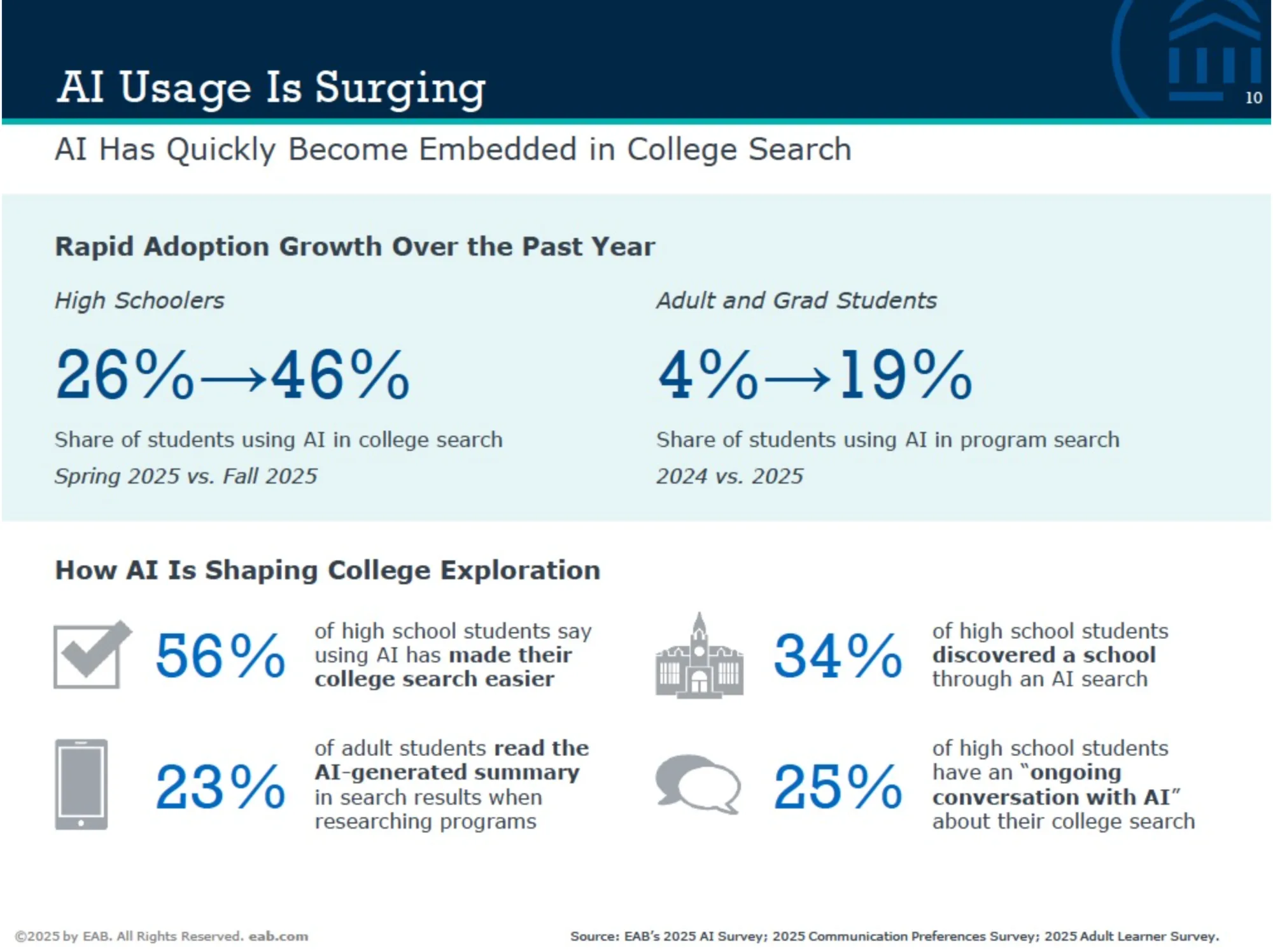
Although AI usage continues to grow, increased adoption doesn’t necessarily translate into greater trust. According to the same EAB survey, 37% of respondents said they were skeptical of information generated by AI search tools—the highest percentage reported—while only 7% said they trust the responses these tools provide.
Lower confidence in AI-generated responses doesn’t imply that people will stop using these tools to learn about us. Instead, they’re more likely to verify the information by consulting additional sources before accepting or rejecting what they’ve been told.
Our content strategy must evolve.
While the above findings suggest that many users remain cautious about AI-generated responses, they shouldn’t lead us to dismiss the importance of how Wake Forest appears in AI-powered search results. Instead, our focus should be on ensuring our content is visible, accurate, and authoritative enough to be cited.
AI offers a level of speed and convenience that few other technologies can match, and its conversational responses make information easy to consume. As more people use these tools to research colleges and universities, our success will increasingly depend not only on how we’re represented in AI-generated answers, but on whether our content is included in those answers at all.
Writing for GenAI (and Humans)
Before making changes to your website, you need to first understand how users are searching for and discovering your content. While GenAI-powered search is becoming increasingly common, most users still use traditional search engine platforms and visit our websites directly to gather information and engage with content. Therefore, we shouldn’t focus all our attention in one place.
Web analytics can tell us how many visitors arrive at our websites from traditional search engines as well as AI-powered tools and platforms. What they can’t always tell us is how many people use generative AI to learn about Wake Forest without ever clicking through to our website. Understanding this “zero-click” behavior is becoming increasingly important as AI changes how users discover and consume information.
The goal isn’t to optimize for GenAI at the expense of human visitors. Instead, create content that serves both audiences. By following the best practices below, you’ll improve the likelihood that your content is discoverable by AI-powered tools while remaining clear, useful, and engaging for the people who visit your website.
Identify how people are using GenAI.
What information are your users looking for?
- Conduct research to better understand your users’ intent and topics of interest. By using the analytics module in Siteimprove and the SEO module, you can identify what pages on your site have received the most interest and what keywords are being searched, then use that information to determine what content becomes a priority.
How are they asking those questions?
- Analyze the natural language questions people are likely to ask and how they use AI-powered and voice search tools. Whenever possible, ask your audience what prompts they use to find information related to your content. This will help you zero in on specific keywords and phrases that may be identified as important to finding specific content.
What information will be found if someone asks the question in both a traditional search engine and AI Generative Search?
- Once you’ve identified the questions and prompts users are likely asking, evaluate the responses. Is your content being cited? If not, what is the source of that information and is it accurate?
Here’s what AI trusts and what it ignores.
What AI search tools look for when selecting content to cite is more similar to what human readers value than you might expect. Both prioritize content that is clear, well-structured, accurate, and easy to understand. The biggest differences lie in how the content is presented and the tone in which it’s written—not in the underlying structure or quality of the information.
AI (and humans) favor content that is:
- Clear: Answers appear early in the copy, often in the first 1–2 sentences.
- Canonical: Facts live in a single, authoritative location—not scattered across pages.
- Structured: Content includes summary boxes, tables, anchors, and schema markup.
- Fresh: Pages are updated regularly and free of stale or conflicting information.
Source: Redefining Visibility: 6 Ways Colleges Can Prepare for the AI Search Shift
AI may ignore content that focuses too heavily on:
- Nuance and Complexity: AI struggles with nuanced information, finding it hard to find facts and clear information.
- Human Experience: Content that contains emotions, is too personalized or is subject to interpretation.
- Niche or Unreliable Content: If your page lacks reputable backlinks and/or is not updated frequently.
Be the authoritative source on your content.
Generative AI tools favor content that is clear, accurate, and consistent. When information is well organized, uses straightforward language, and most importantly provides details such as facts, data, and proven results, AI tools are better able to interpret it and determine its relevance to a user’s question.
While there is no way to guarantee that your content will be cited, maintaining detailed, accurate, and up-to-date information improves the likelihood that it will be recognized as a reliable source.
By creating fact pages, providing clear and direct FAQ sections where appropriate, and reducing your reliance on PDFs, your content will perform better with AI search tools and your users.
Set the tone.
The tone of your content can directly influence what AI searches pick up on and use in their responses. Here are some strategies on what you can do.
- Write content in a clear and concise format and use a strong, singular voice.
- Headings/subheadings may benefit from having a more conversational format.
- Your primary content, including headings, can use a conversational or more personalized tone when it supports your message and audience.
- Include patterns in your writing and content structure whenever possible.
Testing Your Search Prompts
As mentioned earlier, one of the first steps in evaluating your visibility in AI-generated search results is identifying the questions and prompts your audience is using to find information about your content. If you don’t have the opportunity to speak directly with members of your target audience, Siteimprove’s Analytics and SEO modules can provide valuable insights. Review which pages users most frequently land on—an indicator of the content they find most valuable—and the search keywords that lead them to your website.
Once you’ve identified the content your audience is seeking and the keywords or search queries they’re using, you can start testing your prompts and looking for areas in your content that can be improved.
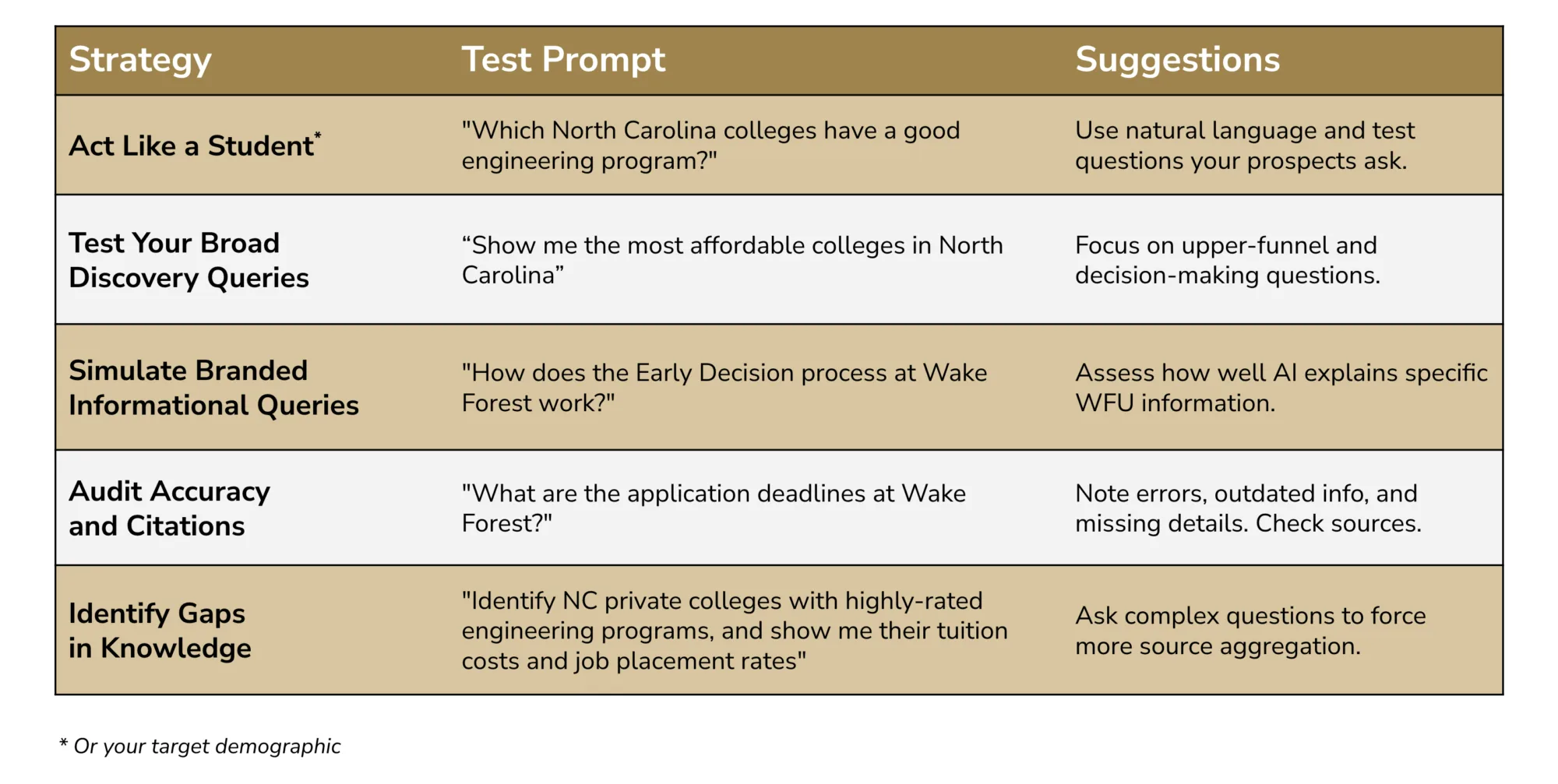
As you work through this rubric, you’ll gain a better understanding of whether your content effectively meets your audience’s needs. If you determine that it doesn’t, consider revising the page to better align with the topics and questions users are searching for. Doing so not only improves the likelihood that your content will be discovered and cited by AI-powered search tools, but also creates a clearer, more engaging experience for the people who visit your website.
Examples
Consider the following example as how to test your search prompts. Once you’ve identified what questions or prompts are important to focus on, look for the most important keywords contained within them.
What are the most affordable colleges in North Carolina?
The user has identified three key concepts: affordable, colleges, and North Carolina. The primary intent behind the search is affordability, while the other terms provide the context needed to narrow the results to colleges located in North Carolina.
What colleges offer the best study abroad program?
The user has identified three key concepts: colleges, best, and study abroad program. The primary intent behind the search is to find the best study abroad program, regardless of what college that happens to be at.
How do I drop a class at Wake Forest?
The user has identified two key concepts: drop a class and Wake Forest. Because the question is specific to Wake Forest, the primary search intent is understanding how to drop a class, with Wake Forest providing the context needed to deliver the correct information.
Once you’ve identified the user’s primary intent, make sure those key terms are clearly addressed throughout the page on your site that contains this information, not just in the page title or a section heading. Reinforcing them within the body content helps both users and AI-powered search tools better understand what the page is about.
In Conclusion
Generative AI—and the ways people use it to discover information—is evolving rapidly. Because of this, there is no single strategy that will guarantee your content is cited across every AI platform or displayed on the first page when a search is performed in Google. Instead, use the guidance in this section as a framework for creating content that is clear, accurate, and valuable to both your audience and the AI tools they rely on.
Above all, remember that your primary audience is people—not technology. Write content that informs, answers questions, and builds trust with your readers. When you create content that genuinely serves your audience, you’re also creating the kind of content that AI systems are more likely to recognize and reference.
Your Digital Strategy Toolbox

Content
A well-defined web content strategy drives user experience, content visibility, and overall website performance.

Analytics
Analytics help you uncover insights, identify trends, and guide improvements for your website content strategy.

GenAI & SEO
How people discover information has changed—and continues to evolve. Here’s why that matters and how to approach it.

Accessibility
An effective website is designed not only for its intended audience, but to ensure everyone can access its content.
Online Presentations
Whether you’re interested in attending an upcoming digital strategy presentation or want to revisit a previous one, explore the topics we cover and resources we share.
Glossary of Terms
Digital strategy involves a lot of terminology that can feel overwhelming. We’re here to help clarify some of the most common terms and concepts you’ll encounter.
Want to Chat?
We’re here to support your digital strategy efforts. Reach out with questions or schedule a consultation with us to discuss your website strategy.